
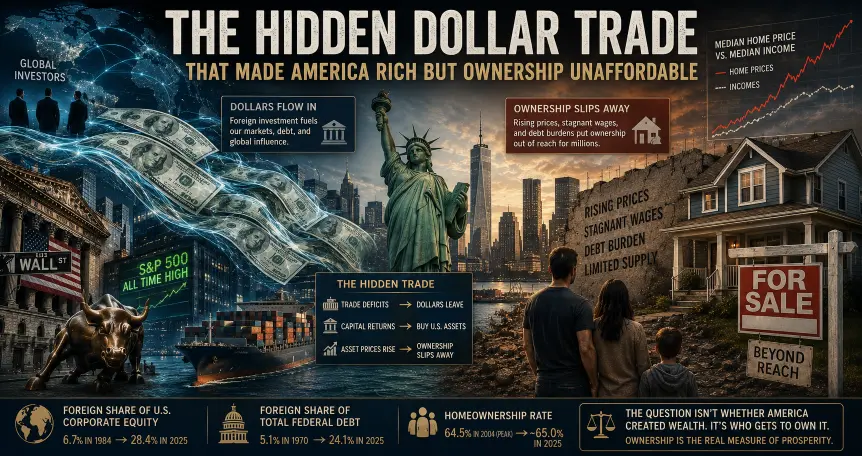
How the World’s Reserve Currency Created The Global Dollar System, Transformed the American Economy, Created Extraordinary Wealth, and May Have Quietly Changed Who Benefits From It
The Question Nobody Is Asking
Millions of Americans are asking the same question today. Why does everything feel so much more expensive than it used to? Housing has become increasingly difficult to afford, healthcare costs continue to rise, childcare rivals a second mortgage for many families, and grocery bills consume a growing share of household budgets. Even Americans earning incomes that would have once been considered comfortable often describe feeling financially trapped.
The explanations offered are usually familiar. Inflation, government spending, interest rates, supply chain disruptions, tariffs, immigration, taxes, and corporate pricing strategies all receive considerable attention. Each of these factors undoubtedly influences prices to some degree. However, focusing exclusively on these individual issues risks overlooking a much larger question about the structure of the American economy itself.
In a previous article, I examined how the global dollar system may help explain why American life keeps getting more expensive. This article takes the analysis one step further by asking what happened to ownership as American assets became increasingly integrated into global financial markets.
The Richest Country in History Feels Increasingly Unaffordable
Perhaps we have been asking the wrong question. Instead of asking why prices have increased, we should begin by asking how the wealthiest nation in modern history became a country where so many working households struggle to accumulate wealth or purchase the assets that previous generations viewed as attainable.
This question becomes even more difficult when viewed through the broader global economy. The United States remains the world’s largest economy, American companies dominate global equity markets, and the U.S. dollar continues serving as the primary reserve currency for international trade and finance. Foreign governments, central banks, pension funds, and institutional investors collectively hold trillions of dollars in Treasury securities and other American financial assets because they continue viewing the United States as one of the safest places in the world to preserve capital.
America Looks Wealthy While Households Feel Financially Trapped
From that perspective, America appears remarkably successful. Yet millions of Americans describe a financial reality that feels fundamentally different. Many work full-time while postponing homeownership, delaying starting a family, relying more heavily on consumer debt, or withdrawing retirement savings simply to maintain their standard of living. Increasingly, some households and businesses are making financial decisions today that shift larger burdens into the future.
How can both of these realities exist simultaneously? How can the United States become wealthier while many Americans feel less financially secure?
The Missing Link Is the Global Dollar System
Answering that question requires looking beyond domestic inflation statistics or annual budget debates. It requires understanding one of the most important financial developments of the last eighty years, namely how the United States gradually became the center of the global monetary system.
Most people assume America primarily exports goods and services. While those exports remain important, they are no longer the country’s greatest economic advantage. The United States exports something far more valuable. It exports access to the U.S. dollar and the financial system built around it.
Understanding how that system developed, why the rest of the world willingly participates in it, and what the United States received in exchange is essential to understanding many of the economic challenges Americans face today. More importantly, it raises a difficult question that deserves thoughtful consideration.
Did the financial system that made the United States extraordinarily prosperous also contribute to making asset ownership increasingly difficult for the Americans living within it?
America Did Not Just Export Products. It Exported Dollars.
When most people think about exports, they think about physical products leaving one country and arriving in another. They picture automobiles, aircraft, agricultural products, energy, technology, and machinery being loaded onto ships, trains, and airplanes before being sold throughout the world. Those exports remain an important part of the American economy, but they are no longer the country’s greatest economic advantage.
The United States exports something far more valuable than any physical product. It exports the ability to transact, save, borrow, invest, and conduct international commerce using the U.S. dollar.
The Dollar Serves More Than the American Economy
To understand why that matters, we first need to understand what the dollar actually represents.
For most Americans, the dollar is simply money. It is what arrives in a paycheck, pays the mortgage, buys groceries, and covers monthly bills. Outside the United States, however, the dollar serves a much larger purpose. It functions as the primary currency for international trade, global banking, commodity markets, sovereign reserves, and financial transactions between countries that may have little direct connection to the United States.
Imagine a manufacturer in Brazil purchasing equipment from a supplier in South Korea. Neither company is American, yet the transaction may still be settled in U.S. dollars. An energy producer in the Middle East may sell oil to a refinery in Asia using dollars rather than either country’s domestic currency. Central banks throughout the world hold substantial reserves of U.S. Treasury securities because they view them as among the safest and most liquid financial assets available.
In other words, the global economy increasingly operates on a financial system built around the U.S. dollar.
Bretton Woods Placed the Dollar at the Center
That system did not develop by accident.
Following World War II, representatives from forty-four nations met in Bretton Woods, New Hampshire, to design a new international monetary system capable of supporting global reconstruction and economic stability. Under the agreement reached in 1944, participating countries generally fixed the value of their currencies to the U.S. dollar, while the United States agreed to redeem dollars held by foreign governments for gold at a fixed rate of $35 per ounce.
This arrangement effectively placed the dollar at the center of international finance. Countries trading with one another increasingly held dollars because dollars could ultimately be exchanged for gold through the United States. Confidence in the dollar therefore became confidence in the American government’s ability to honor that commitment.
Ending Gold Convertibility Did Not End Dollar Demand
The system changed dramatically in 1971 when President Richard Nixon suspended the dollar’s convertibility into gold. The Bretton Woods framework effectively came to an end, and the United States entered a system in which the dollar was no longer backed by a fixed quantity of gold.
Many people assume that ending gold convertibility should have weakened the dollar’s international position. Instead, the opposite occurred.
Over the following decades, the dollar became even more deeply integrated into the global financial system. International trade continued relying heavily on dollars. Commodity markets continued pricing many goods in dollars. Foreign governments continued accumulating dollar reserves. Investors around the world continued purchasing Treasury securities because they believed the United States remained the safest destination for preserving capital.
The dollar gradually became something much larger than America’s currency. It became the world’s financial infrastructure.
Exported Dollars Returned Through American Assets
That distinction created one of the greatest economic advantages any nation has ever possessed. Every time another country accumulated dollars, purchased Treasury securities, or invested in American financial assets, demand for the U.S. financial system increased.
Those dollars did not simply disappear overseas. They frequently returned to the United States through investments in government debt, corporate bonds, stocks, commercial real estate, and other dollar-denominated assets.
Economists often describe this process as dollar recycling. Countries exported goods to the United States, received dollars in return, and then reinvested many of those dollars back into American financial markets. The United States received imported goods, while foreign investors received financial claims on the American economy.
For decades, this arrangement appeared beneficial for nearly everyone involved. Foreign exporters gained access to American consumers. The United States enjoyed lower-cost imported goods and abundant foreign investment. Governments, businesses, and households benefited from lower borrowing costs than might otherwise have existed.
At first glance, it appeared to be an extraordinary success.
The more difficult question is whether the long-term consequences of that arrangement were fully understood, or whether some of the costs simply took decades to become visible.
Why the World Wanted Dollars
The next logical question is obvious. If the United States benefited so greatly from the dollar’s global role, why would the rest of the world willingly participate in the system?
The answer is that the arrangement produced significant benefits for other countries as well.
A Common Currency Made Global Trade Easier
International trade functions much more efficiently when buyers and sellers share confidence in the same currency. If every transaction required converting one nation’s currency into another, businesses would face greater exchange-rate risk, higher transaction costs, and more uncertainty when negotiating long-term contracts.
A widely accepted reserve currency reduces much of that friction.
Over time, the U.S. dollar became that currency.
This did not happen solely because of military strength or political influence. The United States also possessed many of the characteristics investors and governments value most. It had a large and productive economy, relatively stable political institutions, well-developed financial markets, strong property rights, and a financial system capable of supporting enormous volumes of international activity.
Treasury Securities Became a Form of Global Financial Insurance
Perhaps the most important advantage was the Treasury market’s ability to absorb enormous amounts of capital while remaining highly liquid.
Liquidity is often overlooked, but it is one of the dollar’s greatest strengths. Investors, banks, pension funds, insurance companies, and central banks need to know they can buy or sell large amounts of assets quickly without significantly affecting market prices. Few financial markets in history have offered that level of depth better than the market for U.S. Treasury securities.
For central banks, accumulating dollars was therefore not simply about holding American currency. It was about holding financial reserves that could be converted into cash quickly during periods of economic stress.
Treasury securities became a form of financial insurance for governments around the world.
Private investors reached many of the same conclusions. Pension funds sought stable investments capable of preserving wealth over long periods. Insurance companies needed liquid assets to meet future obligations. International corporations required dollars to finance trade, borrow capital, and manage currency risk across multiple countries.
The dollar system became valuable because it provided access to both a currency and a deep financial market built around that currency.
Dollar Dominance Created a Powerful Network Effect
As more countries, businesses, and investors adopted the dollar, participation in the system became increasingly valuable.
Each additional country using dollars made the currency more useful for the next country. Each additional investor purchasing Treasury securities increased market liquidity. Each additional international business conducting transactions in dollars reinforced the dollar’s position as the preferred medium for global commerce.
Economists sometimes describe this as a self-reinforcing cycle. The dollar became dominant because people trusted it, and people continued trusting it because it was already dominant.
The same dynamic exists in many areas of everyday life. People often choose the largest social media platform because that is where everyone else already participates. Businesses frequently adopt the accounting software, operating system, or payment network that most of their customers already use. The value of the network increases as more participants join it.
The global dollar system operates in much the same way.
By the early twenty-first century, enormous portions of international trade, sovereign reserves, corporate borrowing, and global investment depended on dollar-denominated financial markets. That dependence made the system remarkably resilient.
Even during periods of financial crisis, investors often responded by purchasing more Treasury securities rather than fewer because they continued viewing the United States as one of the safest destinations for preserving capital.
Global Dollar Demand Became an American Strategic Advantage
For the United States, this represented an extraordinary strategic advantage.
Foreign governments and investors willingly accumulated dollar-denominated assets because doing so benefited their own economies. At the same time, that demand reduced borrowing costs for the United States, strengthened domestic financial markets, and reinforced America’s influence throughout the global economy.
The arrangement did not require the United States to force every participant into the system. Governments, institutions, and businesses often chose to participate because the alternatives were less liquid, less stable, or less widely accepted.
It was a remarkable arrangement.
The more difficult question is whether Americans fully understood what they were receiving in exchange for those benefits. Every economic system requires trade-offs. Every balance sheet contains both assets and liabilities. The global dollar system was no exception.
To understand those trade-offs, we first need to examine why this arrangement appeared so successful for the United States during its early decades.
The Trade That Looked Brilliant
If someone had described the global dollar system to policymakers in the 1970s or 1980s, it would have sounded almost too good to be true.
Imagine a country that could purchase goods from around the world using its own currency. Imagine that many of the countries receiving that currency would then invest it back into that same country’s government debt, businesses, banks, and financial markets. Imagine further that global demand for those financial assets helped reduce borrowing costs for households, businesses, and the government itself.
That was, in many respects, the position the United States found itself in.
The arrangement produced real and measurable benefits.
American Consumers Gained Access to Lower-Cost Goods
American consumers gained access to lower-cost imported goods from around the world. Clothing, electronics, household products, automobiles, machinery, and countless other items became less expensive than they otherwise would have been. Families were able to purchase products that would have been far more expensive had they been manufactured entirely within the United States.
Businesses benefited as well. Companies gained access to global supply chains that reduced production costs, increased efficiency, and expanded profit margins. Lower input costs often translated into lower consumer prices, higher earnings, or both.
Public companies rewarded shareholders through growing profits, while consumers enjoyed greater purchasing power than might otherwise have been possible.
Foreign Capital Helped Lower Borrowing Costs
The financial system benefited in equally significant ways.
As foreign governments, pension funds, insurance companies, and institutional investors accumulated Treasury securities and other dollar-denominated assets, demand for American financial markets continued growing.
Greater demand for those assets generally supported lower borrowing costs throughout the economy. The federal government could finance deficits at lower interest rates. Businesses could borrow capital more cheaply to expand operations. Homebuyers frequently benefited from lower mortgage rates than would likely have existed without substantial global demand for American debt markets.
Lower borrowing costs did more than make individual loans less expensive. They increased the amount of credit available throughout the economy and gave households, businesses, and governments greater financial flexibility.
American Financial Markets Became More Valuable
The stock market also benefited from this environment. Capital from around the world flowed into American businesses because investors viewed the United States as a stable place to preserve and grow wealth.
Lower interest rates increased the present value of future corporate earnings, while abundant investment capital encouraged innovation, expansion, acquisitions, and entrepreneurship.
The cumulative effect was extraordinary. Consumers purchased less expensive goods, businesses reduced costs, investors earned attractive returns, homebuyers often enjoyed relatively affordable financing, and the federal government borrowed at favorable interest rates.
Foreign countries gained a stable reserve asset and access to the world’s largest consumer market.
From almost every perspective, the arrangement appeared mutually beneficial.
It is therefore not surprising that many economists described the dollar’s global role as one of America’s greatest competitive advantages. The system supported economic growth, strengthened financial markets, reinforced the dollar’s international position, and provided the United States with geopolitical influence unmatched by any other nation.
If we had evaluated the system solely through stock market performance, economic output, international investment, or the strength of American financial institutions, we might reasonably conclude that it was one of the most successful economic arrangements ever created.
Accounting Requires Examining Both Sides of the Trade
However, accounting requires looking beyond one side of the ledger.
Every asset is matched by a liability. Every benefit is accompanied by a cost, even if that cost does not become visible for many years. A business can report impressive revenue growth while quietly accumulating obligations that eventually threaten its future. Nations are no different.
The question, therefore, is not whether the global dollar system benefited the United States.
It clearly did.
The more difficult question is whether some of those benefits gradually obscured costs that were being absorbed elsewhere in the economy. If so, those costs would not necessarily appear in gross domestic product, stock market returns, or Treasury auctions.
They would appear much later in household balance sheets, manufacturing communities, wealth distribution, housing affordability, and the ability of ordinary Americans to accumulate productive assets.
Understanding those costs requires shifting our attention away from financial markets and toward the real economy where Americans live, work, save, and attempt to build wealth.
The Financial Cycle Behind the Trade
The benefits of the global dollar system become easier to understand when foreign investment and the American trade balance are viewed together.
As the United States imported more goods and services than it exported, dollars accumulated in the hands of foreign businesses, investors, and governments. Many of those dollars later returned to the United States through purchases of federal debt and other dollar-denominated assets.
Foreign Demand for American Federal Debt Expanded
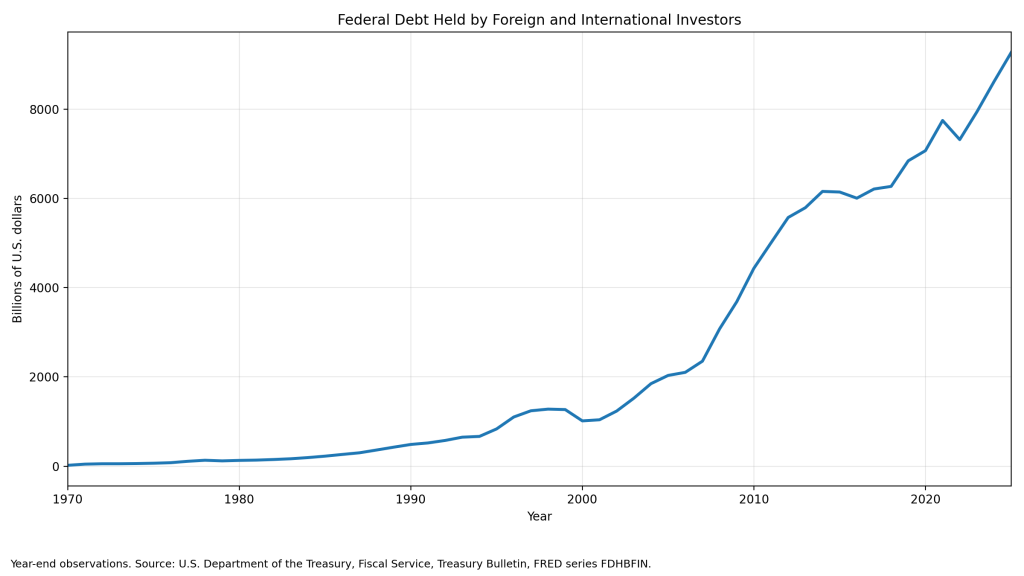
Source: U.S. Department of the Treasury, Fiscal Service, via Federal Reserve Economic Data.
The United States Developed a Persistent Trade Deficit
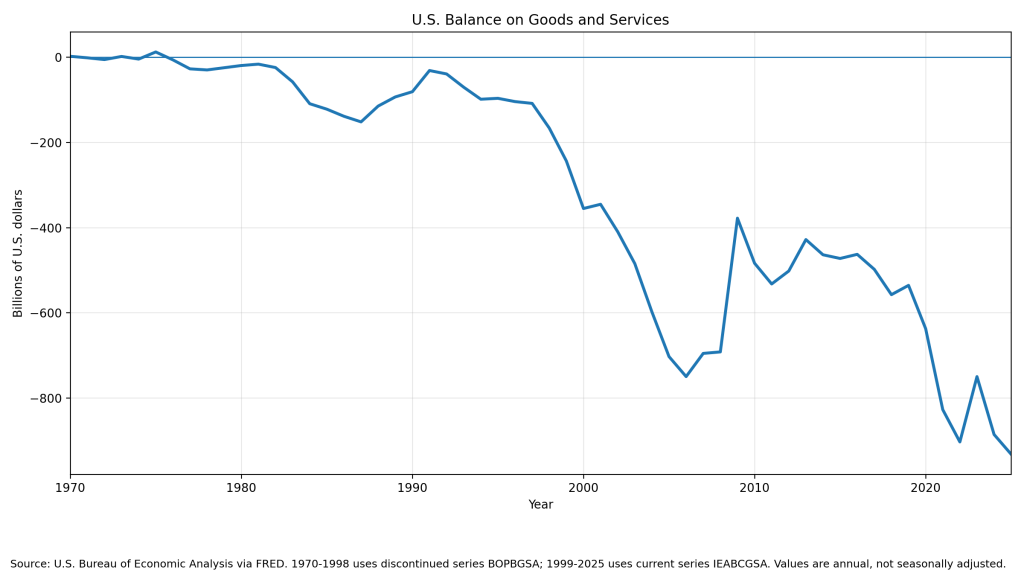
Source: U.S. Bureau of Economic Analysis, via Federal Reserve Economic Data.
Foreign Investors Became a Larger Source of Federal Financing
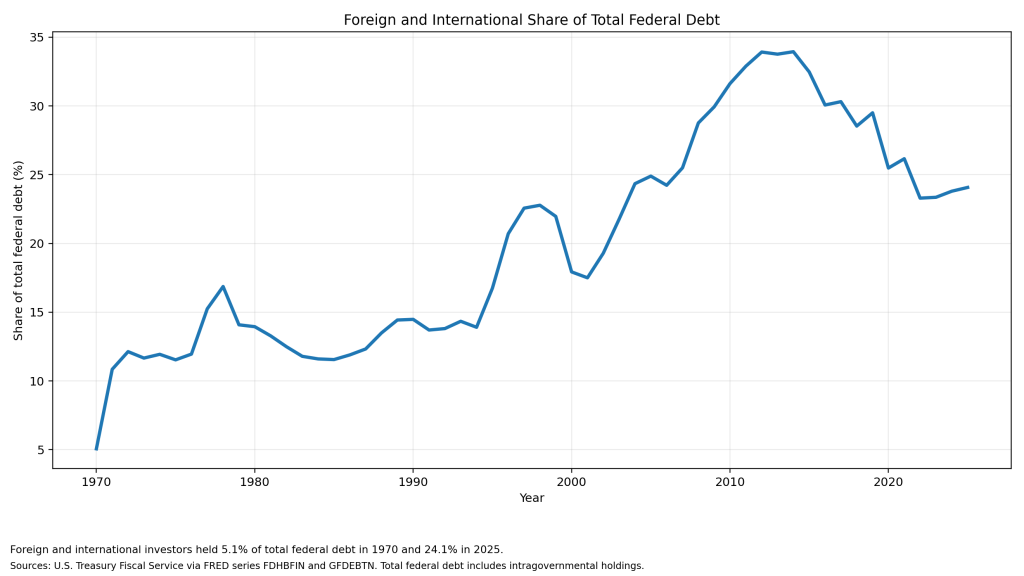
Dollars Sent Abroad Frequently Returned Through Financial Markets
These charts do not prove that rising foreign holdings of federal debt caused the American trade deficit, nor do they suggest that the relationship operated identically in every year.
They illustrate the financial cycle at the center of this article.
The United States purchased goods and services from the rest of the world. Foreign businesses and governments received dollars. Many of those dollars were then reinvested in Treasury securities and other American financial assets. That returning capital helped support U.S. borrowing, liquidity, and asset markets, which made it easier for the United States to continue financing consumption and trade deficits.
From one perspective, the arrangement was extraordinarily efficient. Americans received real goods and services, while foreign investors received liquid dollar-denominated claims on the American economy.
From another perspective, the arrangement made the United States increasingly dependent on the rest of the world continuing to accept dollars and reinvest them in American assets.
The benefits were immediate and highly visible.
The long-term costs were more difficult to identify.
The Costs Nobody Was Measuring
One of the first lessons taught in accounting is that every transaction has two sides. Revenue earned by one party represents an expense to another. An asset acquired by one balance sheet is often matched by a liability somewhere else. Looking at only one side of a transaction rarely tells the complete story.
The global dollar system should be viewed the same way.
The benefits were obvious. Americans enjoyed lower-cost imported goods. Businesses reduced production costs. Investors benefited from rising asset values. The federal government borrowed at favorable interest rates, while financial markets became deeper and more liquid than any others in the world.
Those benefits were measurable, immediate, and easy to celebrate.
The costs were different. They accumulated gradually over decades, often appearing in places that economists do not traditionally associate with international monetary policy.
Lower Prices Came With Lost Productive Capacity
One example was manufacturing.
As transportation improved and trade barriers declined, companies increasingly moved production to countries where labor and operating costs were substantially lower. Consumers generally benefited from lower prices, while businesses improved profitability by reducing expenses. From a corporate balance sheet, those decisions were often rational.
For many communities, however, the experience looked very different. Factories closed, entire supply chains disappeared, and communities that had depended on manufacturing employment for generations saw declining investment, shrinking populations, and fewer opportunities for younger workers.
Those outcomes cannot be attributed solely to the dollar’s global role. Technological change, automation, trade agreements, productivity improvements, tax policy, and corporate decision-making all contributed. Nevertheless, the global monetary system made it easier to sustain an economy that consumed more manufactured goods than it produced domestically.
Cheap Capital Encouraged More Debt
A second cost emerged through debt.
When foreign governments and investors consistently recycled dollars back into Treasury securities and other American financial assets, borrowing became easier than it otherwise would have been. Lower borrowing costs are generally beneficial when borrowed funds finance productive investments that increase future economic output.
Borrowing to build factories, transportation infrastructure, energy production, research facilities, or technology capable of generating future income can strengthen an economy for decades.
Borrowing to finance current consumption produces a very different outcome.
Over time, American households accumulated more consumer debt. Businesses increasingly borrowed to acquire existing companies, repurchase shares, or finance acquisitions. The federal government expanded deficits across multiple administrations, often without facing the borrowing costs that many other countries would have encountered under similar circumstances.
Debt itself was not the problem.
How the borrowed money was used became the more important question.
The Relationship Between Work and Ownership Began Changing
Perhaps the least visible consequence involved the changing relationship between labor and ownership.
For much of the twentieth century, a stable job often provided a realistic pathway toward purchasing a home, accumulating retirement savings, and gradually building wealth. Wages and asset prices generally remained close enough together that many working families could reasonably expect to become owners over time.
That relationship began changing.
Homes appreciated faster than many wages. Financial assets appreciated faster than many wages. Businesses became more valuable faster than many wages. Land appreciated faster than many wages.
The economy increasingly rewarded those who already owned productive assets while making those same assets progressively more difficult for first-time buyers to acquire.
None of these developments occurred because of a single policy decision. They reflected the combined effects of monetary policy, technological progress, globalization, demographics, fiscal policy, financial innovation, regulation, and countless individual decisions made by businesses and consumers over many decades.
The point is not that the global dollar system caused every one of these outcomes.
The point is that it became part of a larger financial environment in which capital increasingly earned higher returns than labor.
Income and Ownership Are Not the Same Thing
That distinction matters because wealth is generally built through ownership rather than income alone.
A paycheck allows a household to consume.
Ownership allows a household to accumulate wealth.
If an economic system causes the price of productive assets to increase faster than the incomes used to purchase them, each successive generation must commit a larger portion of its future earnings simply to acquire the same assets previous generations considered ordinary.
That is not merely an affordability problem.
It is an ownership problem.
The consequences of that shift are difficult to measure in a single economic statistic, but they become increasingly visible when viewed through household balance sheets. Families delay purchasing homes. Retirement savings begin later. Business ownership becomes more difficult to finance. Younger workers remain renters longer. Household debt increases while the age at which many Americans begin accumulating meaningful assets continues rising.
Viewed individually, each of these trends may appear unrelated. Viewed together, they raise a more fundamental question.
Did the United States gradually build a financial system that became exceptionally good at increasing the value of assets while becoming progressively less effective at helping ordinary Americans acquire them?
Answering that question requires separating two ideas that are often treated as though they are the same.
Income and ownership.
Americans did not simply begin competing for higher wages or more dollars. They began competing within a global market for homes, businesses, land, stocks, debt, and other dollar-denominated assets.
That shift changed the meaning of economic security. The central question was no longer only how much a household earned. It was whether those earnings still provided a realistic path toward ownership.
To understand why that path became more difficult, we first need to examine how the competition for American assets expanded far beyond the people living locally.
America Did Not Run Out of Dollars. It Began Competing for Ownership.
One criticism often raised against discussions like this is that dollars are not a finite resource. The Federal Reserve can expand or contract the money supply, banks create credit, and financial markets continuously move capital throughout the global economy. If dollars can be created, how can Americans possibly be running out of them?
They are not. The issue is not the number of dollars in circulation. The issue is what those dollars are competing to purchase.
The Problem Is Not a Shortage of Dollars
For much of American history, households accumulated wealth through a relatively predictable process. A family earned wages, purchased a home, contributed to retirement accounts, perhaps started or invested in a business, and gradually accumulated productive assets over time. Rising incomes and rising asset values generally moved closely enough together that ownership remained attainable for a large portion of the population.
Today, many Americans would argue that relationship feels very different. The challenge is no longer simply earning income. The challenge is converting that income into meaningful ownership before the price of those assets moves further out of reach.
The Competition for American Assets Became Global
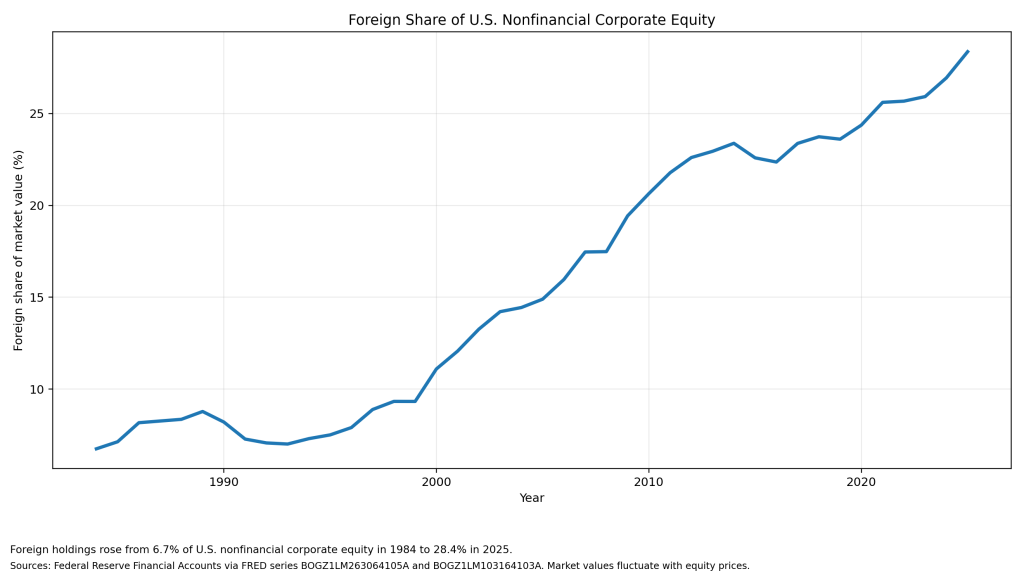
A prospective homeowner is not always competing only with other local buyers. Depending on the market and type of property, that household may also be competing with institutional investors, pension funds, insurance companies, real estate investment trusts, private capital, and international investors searching for stable dollar-denominated assets.
The same principle applies beyond housing. American businesses attract capital from around the world. Commercial real estate is purchased by domestic and foreign investors. Public companies are owned by investors on every continent. Treasury securities are purchased by foreign central banks. Mortgage-backed securities are held by pension funds, insurance companies, sovereign wealth funds, and institutional investors across the globe.
The global dollar system therefore did more than expand the number of people using dollars. It expanded the number of participants seeking to own dollar-denominated assets.
Workers and Investors Build Wealth Differently
That distinction is important because workers and investors generally accumulate wealth in different ways. Workers build wealth by using future earnings to purchase assets. Investors build wealth by already owning assets that appreciate and generate future cash flows.
As more global capital entered American financial markets, demand for dollar-denominated assets increased. Higher demand does not automatically produce higher prices because supply, productivity, regulation, location, and many other factors also matter. However, when the supply of desirable assets grows more slowly than demand, prices generally rise.
This principle is not limited to housing. It applies to businesses, commercial real estate, farmland, stocks, infrastructure, and government debt. Assets that once served primarily local or productive purposes increasingly became investment products available to global pools of capital.
The Same Economy Produces Opposite Experiences
For people who already owned those assets, that development could be extraordinarily beneficial. Rising values increased household net worth, retirement balances, investment returns, and borrowing capacity. For households attempting to acquire those assets for the first time, the same appreciation created a much higher cost of entry.
Each year of rising prices required more future income to purchase the same property, business, or investment. Ownership gradually moved further away, even when wages continued increasing in nominal terms.
This helps explain why two Americans can look at the same economy and reach completely different conclusions. A homeowner whose property has doubled in value may reasonably conclude that the economy has performed exceptionally well. A young family attempting to purchase its first home may conclude exactly the opposite.
Both observations can be true because the dividing line is not always income. It is ownership.
One of the most important economic questions of the coming decades may not be whether America continues creating wealth. It may be whether ordinary Americans can continue acquiring meaningful ownership within the system creating that wealth.
If ownership becomes more concentrated while wages become progressively less capable of purchasing productive assets, the affordability debate changes. The issue is no longer simply that prices increased. The issue is that the path from work to ownership became more difficult.
Housing provides perhaps the clearest example of how that process unfolded.
How Global Capital Changed the American Housing Market
Housing provides one of the clearest examples of what happens when a local necessity becomes part of a global financial market. Most Americans think of a mortgage as a private agreement between a homeowner and a bank. A household borrows money, purchases a home, and makes monthly payments until the loan is repaid. That may be how the transaction begins, but it is often not where the mortgage remains.
Local Mortgages Became Global Financial Assets
After a lender originates a mortgage, the loan may be sold into the secondary mortgage market. Fannie Mae and Freddie Mac purchase mortgages from lenders and either hold them or package them into mortgage-backed securities that can be sold to investors. The lender receives cash from the sale and can use that money to make additional loans. The homeowner continues making monthly payments, but investors may ultimately own financial claims supported by those payments.
This structure solved an important problem. A local bank no longer needed to hold every mortgage it originated for thirty years. It could sell the mortgage, recover its capital, and lend again. By connecting local mortgage lending to national and eventually global capital markets, the United States created a much larger and more reliable supply of housing credit.
That development benefited homebuyers in several ways. A deeper secondary market made mortgage funding more consistently available across regions and economic cycles. Large institutional investors were often better positioned than local lenders to fund long-term mortgages and manage interest-rate and prepayment risks. This helped lower borrowing costs and made the long-term fixed-rate mortgage more widely available than it might otherwise have been.
However, securitization also changed the economic identity of the American home. A house remained shelter for the family living in it, but the mortgage behind that house became an investment product capable of being purchased by pension funds, insurance companies, banks, sovereign institutions, and investors throughout the world.
Foreign investors generally did not purchase an individual homeowner’s mortgage directly. They purchased securities backed by large pools of mortgages or debt issued by the housing agencies supporting those securities. By 2006, foreign investors were financing somewhat more than 10 percent of the more than $8 trillion in U.S. residential mortgages through agency debt, mortgage-backed securities, and related investments. That represented nearly $1 trillion of foreign participation in American housing finance at the time.
This arrangement expanded the pool of money available to finance American homes. A buyer in Iowa was no longer dependent only on deposits held by a local bank. The capital supporting the mortgage could ultimately come from retirement funds, banks, insurers, and investors located across the United States or on the other side of the world.
More Mortgage Capital Did Not Guarantee More Affordable Housing
At first, this appeared to be another extraordinary benefit of the global dollar system. More capital meant more mortgage availability. Greater investor demand could reduce mortgage yields and borrowing costs. Lower monthly payments allowed households to qualify for larger loans, while lenders gained access to a continuous market for the mortgages they originated.
The problem is that cheaper and more abundant credit does not necessarily make housing permanently more affordable. It can also increase the amount buyers are capable of bidding for a limited supply of homes.
If two families can each afford a $1,500 monthly payment, falling interest rates may allow both families to borrow more without increasing that payment. Unless the supply of housing rises accordingly, the additional borrowing capacity can be reflected in higher purchase prices. The monthly payment may initially appear affordable, but the value of the underlying asset rises.
That distinction helps explain why policies intended to make mortgage credit more accessible can eventually make homeownership more expensive for future buyers. Easier financing benefits the first group of purchasers, particularly when they buy before prices adjust. Once higher borrowing capacity becomes embedded in market prices, later buyers must borrow more simply to purchase the same type of home.
Global capital was not the sole cause of rising American home prices. Housing supply restrictions, land-use regulation, construction costs, population growth, household formation, tax incentives, interest-rate policy, lending standards, demographics, and local economic conditions all played substantial roles. The Federal Reserve has emphasized that domestic weaknesses, including declining underwriting standards, regulatory failures, poor risk management, and problems with mortgage securitization, were the primary sources of the housing boom and subsequent financial crisis.
Foreign capital still mattered. During the years preceding the 2008 financial crisis, foreign governments and institutions purchased substantial amounts of Treasury securities, agency debt, agency mortgage-backed securities, and private mortgage securities. Demand for safer American assets helped place downward pressure on longer-term interest rates. European banks and investors also purchased large quantities of private mortgage-backed securities and other structured products, increasing demand for mortgage credit throughout the financial system.
Investor Demand Changed the Mortgages the System Produced
These flows did not merely finance existing mortgages. They influenced what types of mortgages the financial system wanted to create.
When investors demonstrated a strong appetite for mortgage-backed securities, lenders and financial institutions had an incentive to produce more of the loans needed to build those securities. Mortgages became the raw material for a much larger financial production process. Loans were originated, pooled, divided into securities with different levels of risk, assigned credit ratings, and sold to investors looking for yield.
The homeowner viewed the transaction as buying a house. The lender viewed it as originating a loan. The investment bank viewed it as financial inventory. The investor viewed it as a stream of future payments.
Each participant was looking at the same house from a different balance sheet.
This system worked as long as borrowers continued paying, home values remained stable or increased, and investors trusted the securities built from the underlying mortgages. When lending standards deteriorated and increasingly risky loans entered the system, the distance between the borrower and the ultimate investor made the accumulating risk harder to see.
The mortgage originator could sell the loan. The investment bank could package it. The rating agency could evaluate the security. The investor could purchase a claim supported by thousands of borrowers they would never meet.
The structure spread risk across the global financial system, but it also spread responsibility so widely that no single participant had a complete view of the transaction.
Mortgage Losses No Longer Remained Local
When the housing market declined, those mortgage losses did not remain local. They traveled through mortgage-backed securities, banks, pension funds, insurers, investment funds, and international financial institutions. A loan made to a homeowner in one American community could produce losses on a balance sheet in Europe or elsewhere in the world.
That experience revealed how fully American housing had become integrated into global finance.
The lesson is not that securitization or foreign investment was inherently harmful. The secondary mortgage market increased access to capital, improved liquidity, helped standardize mortgage products, and made financing available to millions of households. Those were real benefits.
The more difficult issue is what happens when the purpose of the housing system gradually changes. A system designed to help families finance shelter can also become a system designed to produce financial assets for global investors. Those goals are not always incompatible, but they are not always identical.
A family wants a stable home at a price supported by local income. An investor wants an asset that generates an attractive risk-adjusted return. A lender wants to originate a loan that can be funded or sold. A government wants broad homeownership, financial stability, and continued credit availability.
When all four interests align, the system can work remarkably well. When investor demand, credit creation, and asset appreciation begin moving faster than household income and housing supply, the same system can make existing homeowners wealthier while pushing ownership further away from the next generation.
Greater Global Participation Did Not Produce Broader Homeownership
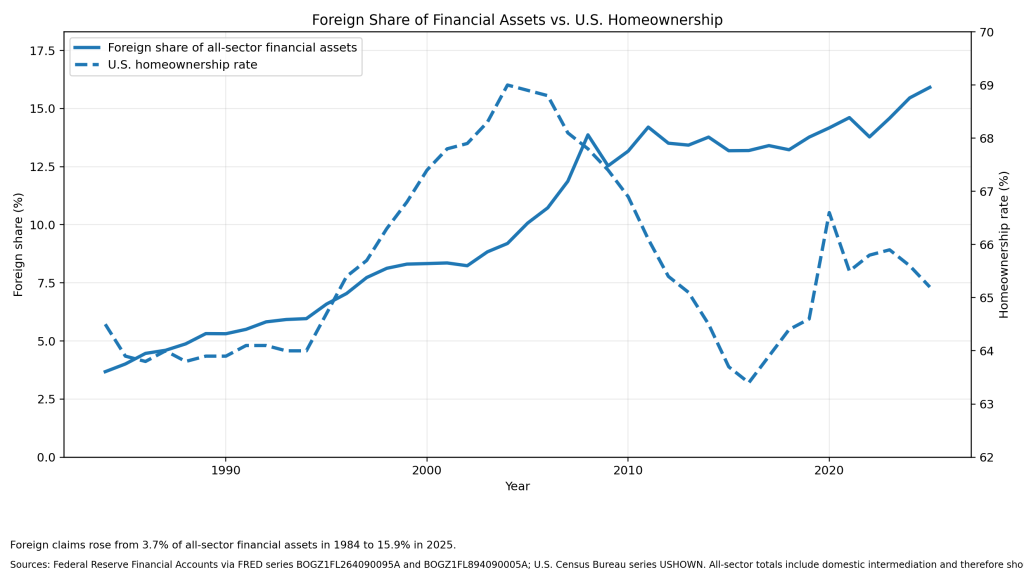
Housing Became Both Shelter and Financial Collateral
This may be one of the most important changes in the American housing market. Homes did not stop being places to live, but they also became collateral supporting one of the largest and most globally connected debt markets in the world.
Once that happened, the price of housing was no longer determined only by what local households earned or what local banks could lend. It became increasingly influenced by national interest rates, global capital flows, investor demand, financial regulation, and the willingness of institutions around the world to hold claims backed by American homeowners.
The globalization of the dollar therefore did not require foreign investors to purchase every American house directly. It only required the debt behind those homes to become globally investable.
That change expanded access to mortgage capital and lowered financing costs, but it also helped transform housing from a primarily local market into a global financial asset class. The consequences of that transformation can still be seen in the widening divide between Americans who already own homes and those still trying to purchase their first one.
The Political Consequences Were Probably Inevitable
Economic systems do not exist in isolation. They shape how people think about opportunity, fairness, government, and their own future. When an economy consistently rewards effort with greater ownership and rising living standards, most people accept that system even if they do not benefit equally.
Problems begin emerging when people feel that relationship breaking down.
The Traditional Path to Economic Security Is Weakening
For much of American history, the promise was relatively straightforward. Work hard, develop valuable skills, save consistently, and over time you could reasonably expect to purchase a home, accumulate retirement savings, perhaps own a business, and leave your children in a stronger financial position than your parents left you.
Whether that promise was universally available is a separate discussion. What matters is that many Americans believed the path existed.
Today, that belief appears to be weakening.
Younger Americans increasingly question whether they will ever own a home comparable to the one their parents purchased. Small business owners face rising financing costs, higher insurance premiums, increasing regulatory complexity, and growing competition from larger firms with access to substantially more capital. Families delay having children because they are uncertain whether they can comfortably afford housing, childcare, healthcare, and education simultaneously.
These experiences naturally influence politics.
Both Political Sides Are Responding to the Same Pressure
When people believe the economic system offers realistic opportunities for advancement, they tend to focus on improving their own position within that system. When they begin believing the system itself no longer works for them, attention shifts toward changing the rules.
That shift is occurring across the political spectrum.
Some Americans conclude that markets have become distorted and require greater regulation, redistribution, or stronger social safety nets. Others conclude that government intervention itself created many of the distortions and that reducing regulation, taxation, and public spending would restore economic opportunity.
Although those policy prescriptions differ dramatically, they often originate from the same underlying experience.
Life feels less affordable.
Ownership feels further away.
The future feels less predictable.
Financial Markets and Households Are Measuring Different Economies
This helps explain why political polarization can intensify even while headline economic statistics appear healthy. Gross domestic product may continue growing. Corporate profits may reach record levels. Equity markets may establish new highs. At the same time, households measuring success by their ability to purchase a home, support a family, or build savings may conclude that the economy is performing very differently than those statistics suggest.
Neither perspective is necessarily wrong.
They are simply measuring different things.
Financial markets measure the value of assets.
Households often measure the ability to acquire them.
That distinction may become increasingly important during the coming decades. If ownership continues concentrating while entry into ownership becomes progressively more expensive, political disagreements may increasingly reflect competing experiences rather than competing interpretations of the same facts.
People who own appreciating assets often experience the economy differently than people attempting to purchase those assets for the first time.
The Real Question Is Whether the Trade Was Worth It
This does not mean conflict is inevitable, nor does it mean the current system cannot adapt. Economies evolve continuously in response to changing technology, demographics, policy choices, and global events. The United States has repeatedly demonstrated an extraordinary capacity for innovation and renewal.
The more immediate question is whether policymakers, economists, and the public are measuring the right indicators.
An economy can produce record asset values while simultaneously making asset ownership less attainable.
A country can become wealthier while many households feel less financially secure.
A reserve currency can strengthen the nation’s financial position while creating challenges that are distributed unevenly among its citizens.
Those realities are not necessarily contradictions. They may simply reflect different sides of the same economic system.
That brings us to perhaps the most important question in this entire discussion.
If the global dollar system produced extraordinary prosperity for the United States while also contributing to many of the challenges Americans experience today, was it ultimately a good trade?
Like any major investment decision, the answer depends not only on what was gained, but also on what was given up.
Did America Actually Have Another Choice?
At this point, it is reasonable to ask an uncomfortable question.
If the global dollar system produced both extraordinary benefits and meaningful long-term trade-offs, why did the United States continue expanding it?
The answer may be that policymakers believed the alternative carried even greater risks.
Policymakers Were Making Decisions Without Hindsight
It is easy to evaluate decades of economic history with the benefit of hindsight. It is much more difficult to make decisions while living through them. Every administration faced its own recessions, financial crises, geopolitical conflicts, technological change, demographic shifts, and competing political priorities. None of those leaders knew how history would ultimately judge their decisions.
More importantly, the United States was not making those decisions in isolation.
Other nations were rebuilding after World War II. International trade was expanding rapidly. Global financial markets were becoming increasingly interconnected. Foreign governments wanted a stable reserve asset. Businesses wanted a common currency for international commerce. Investors wanted liquid financial markets capable of absorbing enormous amounts of capital.
The United States happened to provide all of those things.
Dollar Dominance Became Self-Reinforcing
As more countries adopted the dollar for trade, reserves, and investment, the system became increasingly valuable to everyone already participating in it. Economists often describe this as a network effect. The larger the network became, the more difficult it became for any participant to leave it.
That raises an important question.
Could the United States have realistically refused to supply the world with dollar-denominated assets?
Doing so would likely have required reducing trade deficits, limiting the supply of Treasury securities and other financial assets available to foreign investors, accepting a smaller international financial role, and potentially allowing another country or group of countries to develop a competing reserve system over time.
Refusing the Role Would Have Carried Its Own Costs
Perhaps that would have produced a healthier domestic economy. Perhaps it would have reduced America’s financial influence. Perhaps it would have weakened its geopolitical position. Perhaps it would have forced more domestic production, higher national saving, and greater investment in productive capacity.
Or perhaps it would simply have transferred many of the advantages of reserve currency status to another nation while leaving the United States with fewer strategic options.
We do not know.
History rarely allows controlled experiments.
That is why I hesitate to describe the global dollar system as either a mistake or a triumph. It may have been both.
The United States received extraordinary advantages that few nations have ever enjoyed. Those advantages likely strengthened national security, lowered borrowing costs, supported economic growth, and reinforced America’s position as the center of global finance.
At the same time, those same advantages may have encouraged decisions that gradually weakened parts of the domestic economy, increased dependence on debt, concentrated ownership, and postponed difficult fiscal choices that eventually had to be confronted.
Those outcomes are not necessarily contradictory. They may simply reflect the reality that every major strategic advantage creates incentives that are beneficial when managed carefully and costly when taken for granted.
The Better Question Is Whether America Used the Advantage Wisely
As accountants, we often see businesses with remarkably successful products gradually become dependent upon them. The product continues generating impressive revenue, but management slowly begins delaying innovation, overlooking operational weaknesses, or assuming favorable market conditions will continue indefinitely.
Eventually, the question is no longer whether the product was successful.
The question becomes whether management used that success wisely.
Perhaps the same question now applies to the United States.
The global dollar system may have been one of the greatest strategic and financial advantages any nation has ever possessed.
The more important question is whether America invested that advantage in ways that strengthened its long-term productive capacity, or whether it gradually began relying upon the advantages of the system itself to carry more of the burden.
Was It Actually a Good Trade?
At this point, it is tempting to reach a simple conclusion. Some readers may conclude that the global dollar system was one of the greatest economic achievements in modern history. Others may conclude that it hollowed out the American middle class and concentrated wealth among those who already owned financial assets.
The reality is probably more complicated.
As accountants, we are trained to evaluate transactions rather than emotions. Every major investment decision has both advantages and disadvantages. A business may acquire another company and dramatically increase revenue while simultaneously taking on debt, integration risk, and operational complexity. Declaring the transaction a success or failure requires evaluating both sides of the balance sheet.
The global dollar system deserves the same treatment.
The Benefits to the United States Were Extraordinary
There is little question that the United States benefited enormously from the dollar’s international role. Americans gained access to lower-cost imported goods, businesses obtained financing through the deepest capital markets in the world, the federal government borrowed at interest rates many countries could only hope to achieve, and investors accumulated extraordinary wealth as American financial markets expanded.
Those benefits were real.
The United States became the center of global finance. American capital markets became the destination for investment from around the world. The dollar became the currency in which governments saved, businesses borrowed, commodities were priced, and international commerce increasingly operated.
Very few nations in history have possessed that level of financial influence.
The Real Question Is How America Used the Windfall
The more difficult question is whether the benefits generated by that system were invested in ways that strengthened America’s long-term productive capacity.
Imagine a business that receives an unexpected windfall. Management could invest those resources into research and development, modern manufacturing facilities, infrastructure, employee training, or technologies capable of increasing future productivity. Alternatively, it could use the money to support higher current spending, distribute larger dividends, repurchase shares, or postpone difficult financial decisions.
Both choices produce benefits.
Only one substantially increases future productive capacity.
That distinction may also apply to the United States.
The issue may not be that foreign capital flowed into American financial markets. The issue may be how much of that capital ultimately financed future productivity compared with current consumption.
If decades of relatively inexpensive financing had produced significantly greater investment in infrastructure, housing supply, advanced manufacturing, energy production, workforce development, scientific research, and other productive assets, the affordability challenges facing many Americans today might look very different.
Instead, a meaningful portion of those benefits appears to have been absorbed through persistent federal deficits, rising household debt, financial engineering, consumption, and appreciation in existing assets.
That observation is not intended as criticism of any single administration, political party, or generation. These decisions accumulated over many decades under both Republican and Democratic leadership. Consumers preferred lower prices. Businesses sought greater efficiency. Investors pursued higher returns. Politicians responded to voters demanding both lower taxes and higher public spending. Foreign governments continued purchasing dollar-denominated assets because doing so benefited their own economies.
Each participant made decisions that appeared rational within their own incentives.
Collectively, those decisions produced an economy that became extraordinarily successful at creating financial wealth while making entry into ownership progressively more expensive for many households.
Was the System Flawed, or Was the Advantage Poorly Managed?
That raises another question that deserves consideration.
Was the transaction itself flawed?
Or did the United States simply fail to invest the proceeds as effectively as it could have?
Those are very different conclusions.
If the system itself is fundamentally flawed, then policymakers must eventually consider whether the benefits of reserve currency status continue outweighing its costs.
If, however, the system remains one of America’s greatest strategic advantages, then abandoning it may create far greater problems than the ones we are attempting to solve.
Perhaps the better question is not whether America should have become the center of the global monetary system.
Perhaps the better question is whether America used that extraordinary position to build an economy capable of producing broad-based prosperity for future generations.
As a CPA, I find that question far more interesting than asking whether the system was simply good or bad.
Every Balance Sheet Eventually Reveals the Cost
Every balance sheet tells two stories.
One describes what was acquired.
The other describes what it cost.
The global dollar system unquestionably created extraordinary wealth for the United States.
The debate that will likely define the coming decades is whether that wealth was converted into lasting productive capacity, or whether too much of it was consumed while assuming the advantages of the system would continue indefinitely.
What Should We Be Watching Next?
No one knows how the global monetary system will evolve over the next several decades. The United States has maintained the world’s primary reserve currency for generations, and despite periodic predictions of its decline, the dollar continues to occupy a dominant position in global trade, finance, and investment.
That does not mean the system will remain unchanged.
Economic systems are constantly adapting to new technologies, changing demographics, shifting geopolitical relationships, and evolving financial markets. Stablecoins, digital payment networks, artificial intelligence, financial automation, and changes in international trade all have the potential to influence how dollars move throughout the global economy.
The question is not whether change is coming.
The question is whether those changes will strengthen or weaken the relationship between work, ownership, and opportunity for ordinary Americans.
As a CPA, there are several indicators I believe deserve more attention than they currently receive.
Can Younger Generations Still Convert Work Into Ownership?
The first indicator is ownership. Are younger generations acquiring homes, businesses, retirement assets, and productive investments at a pace comparable to previous generations, or is ownership becoming increasingly concentrated among those who already possess significant wealth?
An economy can produce impressive headline statistics while quietly becoming less accessible to new participants. If incomes continue rising but the cost of acquiring productive assets rises faster, the path from work to ownership will continue narrowing.
The question is not simply whether Americans are earning more. It is whether those earnings still provide a realistic opportunity to build a balance sheet.
Is Capital Creating New Capacity or Inflating Existing Assets?
The second indicator is productive investment. Is capital being directed toward activities that increase the country’s future productive capacity, such as infrastructure, housing construction, energy production, manufacturing, research, and workforce development?
Or is an increasing share of investment simply bidding up the value of assets that already exist?
These activities can look similar in financial markets because both may increase asset values. Economically, however, they are very different. Building additional housing, productive facilities, energy systems, and technology can increase future supply and output. Continually increasing the price of existing homes, land, businesses, and financial assets does not necessarily create the same productive benefit.
The distinction will help determine whether future prosperity is built on greater productive capacity or increasingly expensive claims on what the country already owns.
Are Household and Small-Business Balance Sheets Strengthening?
The third indicator is household financial resilience. If rising numbers of Americans begin relying on consumer debt, retirement withdrawals, unpaid taxes, or other forms of future financial distress to meet current living expenses, those behaviors may indicate that financial pressure is becoming structural rather than temporary.
A healthy economy should allow households to build balance sheets, not gradually consume them.
Business formation deserves attention for the same reason. Throughout American history, entrepreneurship has been one of the country’s greatest engines of ownership and wealth creation. If financing, regulation, insurance costs, or competitive pressures increasingly prevent ordinary Americans from starting and growing businesses, the long-term effects extend far beyond individual entrepreneurs.
They affect employment, innovation, competition, and the distribution of ownership throughout the economy.
A country in which fewer people can build durable household or business balance sheets may continue producing economic growth while becoming less financially resilient underneath the surface.
Will Technology Extend or Weaken Dollar Dominance?
Finally, we should continue monitoring the international role of the dollar itself. Reserve currency status has provided extraordinary advantages to the United States for decades, but it also carries responsibilities and trade-offs.
Stablecoins may extend dollar access to billions of people who do not have traditional American bank accounts. Digital payment systems may make dollar-denominated transactions faster and easier across borders. At the same time, competing currencies, alternative settlement networks, geopolitical realignment, and changing trade relationships may gradually reduce reliance on the dollar.
Whether those developments strengthen or weaken global demand for dollar-denominated assets will influence American borrowing costs, financial markets, trade, and geopolitical power for generations.
Perhaps the most important lesson from this discussion is that economic systems should not be judged solely by the size of financial markets or the level of national output. Those measurements are important, but they are incomplete.
An economy ultimately succeeds when ordinary people can convert productive work into meaningful ownership.
If that relationship strengthens, prosperity tends to become more broadly shared.
If that relationship weakens, rising wealth can coexist with growing financial insecurity.
That may be one of the most important economic indicators we rarely measure directly.
My Final Thoughts
One of the reasons I became an accountant is that accounting has a way of removing emotion from complicated discussions. Politics change. Markets rise and fall. Opinions differ. Eventually, every major financial decision can be evaluated by looking at what was acquired, what was sacrificed, and whether the long-term return justified the cost.
The global dollar system deserves that same level of analysis.
There is little question that it transformed the United States into the financial center of the modern world. It lowered borrowing costs, strengthened American capital markets, expanded international trade, increased global demand for U.S. financial assets, and provided the United States with an extraordinary level of economic influence.
Those achievements helped create immense prosperity.
The question this article asks is not whether those benefits existed.
They clearly did.
The more difficult question is how those benefits were distributed and whether enough of them were converted into productive capacity, broad ownership, and long-term financial security for ordinary Americans.
Over time, foreign investors came to hold a larger share of American federal debt and a substantially larger share of U.S. corporate equity. American businesses, government securities, mortgages, and other financial assets became increasingly integrated into global investment markets.
That expansion was not inherently harmful. It brought capital into the United States, improved liquidity, supported borrowing, and reinforced the dollar’s international role.
However, the charts throughout this article reveal an important imbalance.
Foreign participation in American financial assets expanded substantially, while the national homeownership rate remained within a comparatively narrow range and below its 2004 peak. The value of American businesses and financial assets increased, but the path from earning income to acquiring meaningful ownership became more difficult for many households.
That does not prove foreign investment caused declining affordability or weaker homeownership. Housing supply, interest rates, lending standards, tax policy, regulation, demographics, technology, and domestic investment decisions all contributed to the outcome.
It does show that a larger and more globally connected financial system did not automatically create broader ownership for the Americans living within it.
That distinction matters.
A country can attract enormous amounts of capital without ensuring that ordinary households gain a larger stake in the resulting prosperity. Financial markets can grow deeper, asset values can rise, and national wealth can expand while the cost of acquiring a home, business, land, or productive investment moves further beyond the reach of wages.
The real question is therefore not whether global capital benefited the United States.
It did.
The question is whether the United States used that advantage to build more productive capacity and create more owners, or whether too much of the benefit became absorbed by higher asset prices, growing debt, persistent government deficits, current consumption, and financial markets that increasingly rewarded those who already owned assets.
Did we use decades of relatively inexpensive capital to build more housing, modernize infrastructure, strengthen manufacturing, improve workforce productivity, encourage entrepreneurship, and expand opportunities for future generations?
Or did we allow an extraordinary financial advantage to make difficult decisions easier to postpone?
I do not pretend to know the complete answer.
History rarely provides complete answers while we are living through it.
What I do know is that millions of Americans are asking the same question in different words.
Why does an economy that appears so wealthy and successful feel increasingly difficult to participate in?
That question deserves more than political slogans or simplistic explanations. It deserves careful analysis because the answer will influence monetary policy, fiscal policy, tax policy, housing, financial markets, and the opportunities available to future generations.
Perhaps the affordability crisis is not simply an inflation problem.
Perhaps it is an ownership problem.
Perhaps the most important measure of economic success is not whether the United States continues creating wealth, attracting capital, or increasing the value of its financial markets.
Perhaps the more important measure is whether productive work still provides ordinary Americans with a realistic path toward owning a meaningful share of that prosperity.
If it does, the global dollar system may ultimately be remembered as one of the greatest economic achievements in history.
If it does not, history may reach a different conclusion. It may determine that America built the world’s most powerful financial system, attracted capital from every corner of the globe, and increased the value of its assets while gradually making meaningful ownership more difficult for many of the people living inside it.
Before we decide whether that trade was ultimately worth making, however, we should first understand who actually owns the assets created by this system today. Homes, businesses, farmland, Treasury securities, corporate equities, and even the mortgages behind American housing all appear somewhere on someone’s balance sheet. Examining those balance sheets may reveal that the ownership question is just as important as the affordability question.
As a CPA, I hope we continue asking those questions before history answers them for us.
Because every balance sheet eventually tells the truth.
The only question is whether we are willing to read the balance sheet before history closes the books.