
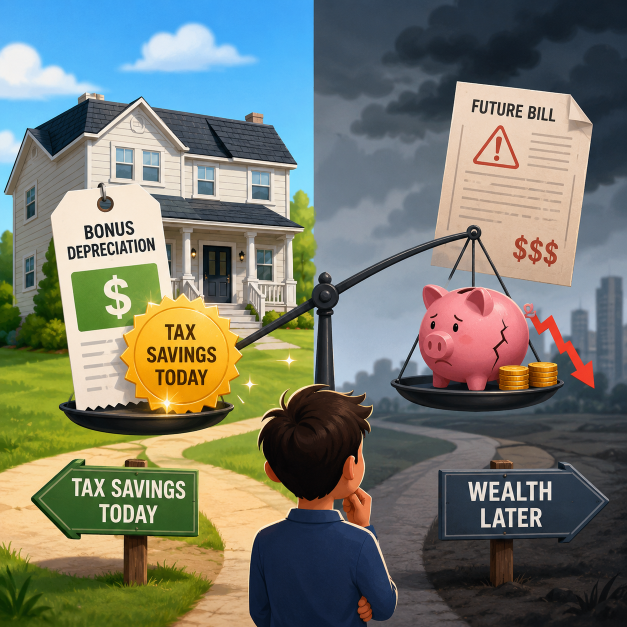
A large tax deduction can feel like winning. But tax savings and wealth creation are not the same thing.
You buy an investment property. Your tax bill drops. You keep more cash. Everyone involved feels smart.
But a lower tax bill does not automatically mean you became wealthier.
That is the mistake many investors make.
They measure the success of an investment by the tax benefit they received at the beginning instead of the wealth they have left at the end.
Why Tax Savings and Wealth Creation Are Not the Same
Tax savings are immediate.
You can point to the number on the tax return.
You can compare what you owed before and after the deduction.
You can say:
“This strategy saved me $40,000.”
That feels real because it is easy to measure.
But many of the costs connected to that decision are harder to see:
- Years of negative cash flow
- Rising insurance and repair costs
- Interest paid to the bank
- Time spent managing the property
- Lost opportunities to invest elsewhere
- A declining property value
- Taxes triggered when the property is sold
A deduction is one part of the investment.
It is not the final score.
A Tax Benefit Cannot Fix a Bad Investment
Imagine buying a vending machine that loses $500 every month.
Someone tells you that buying it will create a large tax deduction.
Would that make the machine a good investment?
No.
You might pay less tax this year, but you still own a machine that loses money.
Real estate works the same way.
A tax deduction can improve a profitable investment.
It cannot repair:
- A property purchased at too high a price
- Weak rental demand
- Expensive financing
- Poor management
- Unrealistic income projections
- Too much debt
- A forced sale
The investment must work before the tax benefit is added.
Why Investors Chase Deductions
People naturally prefer rewards they can receive now.
A tax deduction creates an immediate feeling of progress.
The investor sees a smaller tax bill and feels richer.
The future costs feel distant and uncertain.
This creates a dangerous pattern:
- The deduction becomes the main attraction.
- The investor gives less attention to cash flow and risk.
- The purchase feels safer because a tax professional or salesperson approved the strategy.
- The investor assumes the tax benefit will protect them if the property performs poorly.
But tax laws do not remove investment risk.
They often change the timing of when money is taxed.
Tax Deferral Is a Trade With the Future
Many tax strategies are really trades.
You receive a benefit today in exchange for giving something up later.
That trade can be valuable.
Keeping more cash today may allow you to:
- Pay down high-interest debt
- Improve the property
- Build emergency reserves
- Purchase another productive asset
- Invest for long-term growth
But the benefit depends on what you do with the cash.
Suppose two investors each save $40,000 in taxes.
One invests the money and earns returns for ten years.
The other spends it.
They received the same deduction, but they did not create the same wealth.
The deduction created an opportunity.
It did not guarantee the outcome.
This is the key difference between tax savings and wealth creation. The deduction creates an opportunity, but the investor’s decisions determine whether that opportunity becomes lasting wealth.
Debt Changes the Entire Story
Debt can help an investor control a large asset with less cash.
That can be powerful when the property performs well.
It can also become dangerous when:
- Rental income falls
- Interest costs are high
- Repairs increase
- The property loses value
- The investor needs to sell early
The bank still expects to be repaid.
The investor may have enjoyed a large deduction at the beginning, but most of the sale proceeds may later go to the lender.
That is why the most important number is not always the tax deduction.
It may be the cash that remains after:
- The mortgage is paid
- Selling costs are paid
- Taxes are paid
- The original investment is recovered
The Tax Code Shapes Behavior
The tax code does more than collect revenue.
It encourages people to act.
Governments use tax incentives to influence:
- Business investment
- Homeownership
- Retirement savings
- Energy projects
- Real estate development
- Hiring
- Equipment purchases
That does not mean every encouraged activity is good for every person.
An incentive may be helpful for one investor and harmful for another.
The government may want more investment in certain assets.
That does not mean you personally should buy one.
The tax code is written for broad economic goals.
Your financial plan should be written for your life.
Do Not Let the Incentive Become the Decision
A tax incentive should be one factor in a decision.
It should not become the reason for the decision.
Before buying an investment, ask:
Would I still want this investment if the tax benefit disappeared?
That question removes the excitement of the deduction and forces you to examine the underlying economics.
Would you still like:
- The expected cash flow?
- The debt payments?
- The maintenance burden?
- The location?
- The risk?
- The management demands?
- The likely resale value?
When the answer is no, the tax benefit may be hiding a weak investment.
The Difference Between a Tax Strategy and a Wealth Strategy
A tax strategy asks:
How can I reduce tax?
A wealth strategy asks:
What decision leaves me in the strongest long-term position?
Sometimes the answers are the same.
Sometimes they are not.
A wealth strategy considers:
- Taxes
- Cash flow
- Debt
- Risk
- Time
- Flexibility
- Family goals
- Opportunity cost
- Exit options
The goal is not to avoid every dollar of tax.
The goal is to keep and grow more wealth after every cost is considered.
A Better Way to Judge an Investment
Instead of asking only how much the deduction saves, ask:
What cash will this property produce?
A property that consistently loses money may not be rescued by a one-time tax benefit.
How much debt am I taking on?
Heavy leverage gives the investor less room for mistakes.
How long can I hold it?
Many strategies work better when the owner has time and flexibility.
What happens if income falls?
A good plan should survive more than the best-case forecast.
What will I do with the tax savings?
The benefit is stronger when the cash is invested productively.
How do I eventually get out?
Every investment should have an exit plan before problems appear.
Good Advice Should Sometimes Feel Uncomfortable
Weak advice often gives people what they want to hear:
“Here is how much you can deduct.”
Better advice may say:
“Yes, you can do this—but it may not be good for you.”
That conversation is harder.
It requires the advisor to explain tradeoffs instead of selling excitement.
It also requires the investor to accept that the largest deduction is not always the best choice.
A trusted advisor should not only help you identify opportunities.
They should help you recognize when an opportunity does not fit your plan.
The Real Measure of Success to achieve tax savings and wealth creation
A strategy should not be judged on the day the deduction appears.
It should be judged when the full story is known.
After the property has been operated.
After the debt has been paid.
After the sale costs have been deducted.
After the tax bill has arrived.
After you know what remains for you and your family.
That is the difference between appearing wealthier today and actually building wealth over time.
Before You Sell
Investors who have already claimed large real estate depreciation deductions may face complicated tax questions when they sell.
Those questions can involve adjusted basis, depreciation recapture, debt, selling costs, passive losses, and the character of the gain.
Corridor Consulting explains those technical issues in detail here:
Bonus Depreciation Recapture: The Tax Trap When You Sell
Final Thought on Tax Savings and Wealth Creation
A tax deduction is not a business model.
It is not cash flow.
It is not appreciation.
It is not financial security.
It is one tool.
Used carefully, it can help build wealth.
Used as the reason to make an investment, it can distract you from the risks that matter most.
The best tax strategy is not always the one that saves the most today.
It is the one that leaves you and your family in the strongest position tomorrow.










One Response
Well written article. the step-by-step details were very helpful. Looking forward to your next post.