
Have you ever wondered how banks create money or where the funds for a new mortgage actually come from?
Most people imagine a bank as a giant piggy bank. Customers deposit money, and the bank takes some of that money and lends it to someone else.
That explanation is simple, but it is incomplete.
Modern banks can create new deposit money when they make loans. However, banks cannot create every type of money, and they still need financial resources to complete payments when money moves to another bank.
To understand how banks create money, we first need to separate three different kinds of money.
The Three Types of Money in the Banking System
People often use the word “money” to describe several different things.
Physical cash
Physical cash includes the paper bills and coins in your wallet.
Banks keep some physical cash in their branches and vaults so customers can make withdrawals. However, most purchases today do not involve paper money.
Bank deposits
Bank deposits are the balances shown in checking and savings accounts.
When your bank account says you have $1,000, that balance is money you can spend. But it is also a promise from the bank.
The bank owes you $1,000 and must either:
- give you physical cash;
- transfer the money to another account; or
- use it to pay someone on your behalf.
Most money used by families and businesses consists of bank deposits rather than paper currency.
Federal Reserve balances
The balances banks hold in these accounts are called reserves.
Banks use reserves to complete payments with other banks.
Ordinary customers cannot use these reserve accounts. They are mainly used by banks and certain financial institutions.
How Banks Create Money When They Make Loans
Suppose a bank approves a $200,000 mortgage.
The bank does not necessarily take $200,000 from another customer’s savings account.
Instead, it records two things on its books.
First, the bank records that the borrower owes it $200,000.
That mortgage is an asset to the bank because the borrower must repay it.
Second, the bank credits $200,000 to the borrower’s account or to a temporary closing account.
That deposit is a liability because the bank now owes the money to the borrower or closing company.
The bank’s journal entry looks like this:
| Bank’s accounting records | Debit | Credit |
|---|---|---|
| Mortgage loan receivable | $200,000 | |
| Borrower deposit or closing payable | $200,000 |
The mortgage loan and the new deposit are created at the same time.
This is the basic answer to the question of how banks create money:
A bank creates a new deposit by recording a loan as an asset and the borrower’s deposit as a liability.
Does the Bank Create Free Wealth?
The bank creates spendable deposit money, but it does not create free wealth.
The borrower receives a $200,000 deposit, but the borrower also accepts a $200,000 debt.
The bank receives a $200,000 loan asset, but it also accepts a $200,000 obligation to transfer or pay the deposit.
The new money is matched by new debt.
No one has simply discovered $200,000 that never has to be repaid.
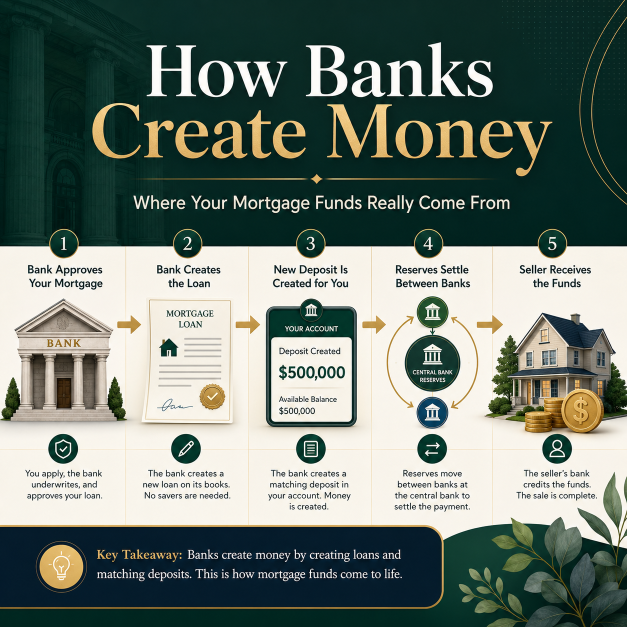
How Banks Create Money for a Mortgage
Suppose a buyer borrows $200,000 from Bank A to purchase a home.
The home seller uses Bank B.
At closing, Bank A must send the mortgage proceeds to Bank B.
The simplified process looks like this:
- Bank A approves the mortgage.
- Bank A records a $200,000 mortgage asset.
- Bank A creates a $200,000 deposit or closing balance.
- The closing company tells Bank A to send the money.
- Bank A transfers reserves to Bank B.
- Bank B credits the seller’s account.
At the end of the transaction:
- Bank A owns the mortgage.
- Bank A has fewer reserves.
- Bank B has more reserves.
- The seller has a bank deposit.
- The buyer owns the home and owes the mortgage.
The Journal Entries for a Mortgage
Step 1: Bank A creates the mortgage and deposit
| Bank A | Debit | Credit |
| Mortgage loan receivable | $200,000 | |
| Closing deposit or payable | $200,000 |
At this stage, Bank A has created a new deposit.
Step 2: Bank A sends the funds to Bank B
| Bank A | Debit | Credit |
| Closing deposit or payable | $200,000 | |
| Reserve balance | $200,000 |
The temporary deposit liability disappears when the payment is sent.
Bank A now owns the mortgage but has $200,000 fewer reserves.
Step 3: Bank B receives the payment
| Bank B | Debit | Credit |
| Reserve balance | $200,000 | |
| Seller’s bank deposit | $200,000 |
Bank B receives reserves and credits the seller’s account.
What Happens If the Seller Uses the Same Bank?
Suppose both the buyer and seller use Bank A.
In that case, Bank A may not need to transfer reserves to another bank.
It can simply move the deposit from the buyer’s closing account to the seller’s checking account.
| Bank A | Debit | Credit |
| Buyer’s closing deposit | $200,000 | |
| Seller’s checking deposit | $200,000 |
The bank still owns the mortgage and still owes a $200,000 deposit.
The deposit now belongs to the seller instead of the buyer.
No reserves leave Bank A because the payment stays inside the same bank.
How Banks Create Money Without Using Another Depositor’s Account
When a bank makes a loan, it does not usually remove the exact loan amount from another customer’s account.
The bank creates the borrower’s deposit through its accounting records.
However, this does not mean customer deposits are unimportant.
Customer deposits provide banks with a stable and relatively inexpensive source of funding.
A bank that continually loses deposits to other banks may also lose reserves. It must replace those reserves or reduce its lending.
Banks do not match each individual loan with another customer’s specific deposit. Instead, they manage all of their loans, deposits, reserves, investments, borrowings, and capital together.
Why Banks Still Need Reserves After Creating Money
A commercial bank can create a new customer deposit, but it cannot create Federal Reserve reserves.
That distinction is important.
When a borrower sends money to someone at another bank, the originating bank must transfer reserves through the banking system.
Bank A cannot simply tell Bank B:
“We created a deposit, so please accept our promise.”
Bank B expects payment through reserves or another accepted settlement method.
That is why a bank can create the initial deposit but still needs enough liquidity to complete the transaction.
Where Banks Get the Reserves They Need
If Bank A needs reserves to complete a mortgage payment, it has several options.
Use reserves it already holds
Banks normally keep reserve balances and other liquid assets available to handle ordinary payments.
If Bank A already has enough reserves, it can transfer them to Bank B.
Receive payments from other banks
Money constantly moves in both directions.
On the same day Bank A sends money to Bank B, customers at other banks may send money into Bank A.
Those incoming payments may bring reserves into Bank A.
Attract new customer deposits
Bank A can encourage customers to place money into:
- checking accounts;
- savings accounts;
- money-market accounts; or
- certificates of deposit.
When money moves into Bank A from another bank, Bank A generally receives reserves along with the new deposit liability.
Sell an investment
The bank may sell Treasury securities or another marketable asset.
If another institution purchases the security, Bank A can receive reserves in exchange.
The bank has not created new reserves. It has exchanged one asset for another.
Borrow from another bank
Bank A may borrow reserves from another financial institution.
Bank A could record:
| Bank A | Debit | Credit |
| Reserve balance | $200,000 | |
| Borrowing from another bank | $200,000 |
The lending bank gives up reserves and receives a loan asset.
The total amount of reserves in the banking system does not increase. Existing reserves simply move from one institution to another.
Borrow from the Federal Reserve
A qualified bank may also borrow from the Federal Reserve.
The bank must generally provide acceptable collateral and repay the loan with interest.
Bank A would record:
| Bank A | Debit | Credit |
| Reserve balance | $200,000 | |
| Loan payable to Federal Reserve | $200,000 |
The Federal Reserve records a loan to Bank A and credits Bank A’s reserve account.
This transaction creates additional reserves while the Federal Reserve loan remains outstanding.
Does the U.S. Treasury Supply Bank Reserves?
Normally, no.
The U.S. Treasury and the Federal Reserve perform different jobs.
What the U.S. Treasury does
The Treasury:
- collects federal taxes;
- pays federal government expenses;
- manages the government’s cash;
- issues Treasury bills, notes, and bonds; and
- borrows money for the federal government.
What the Federal Reserve does
The Federal Reserve:
- manages monetary policy;
- influences short-term interest rates;
- maintains reserve accounts for banks;
- supports payment settlement;
- supplies physical currency; and
- can lend reserves to eligible financial institutions.
The Treasury maintains its own account at the Federal Reserve.
When taxes are collected, reserves may move from commercial banks into the Treasury’s account.
When the Treasury spends money, reserves may move back into commercial banks.
However, the Treasury does not normally cover an individual bank’s reserve shortage.
The Federal Reserve is the institution that can create additional reserves for the banking system.
Why Customer Deposits Still Matter
It may sound as though banks do not need customer deposits because they can create deposits when making loans.
That conclusion would be incorrect.
Customer deposits remain important because they provide banks with relatively stable and affordable funding.
A bank that makes many loans but continually loses deposits to other banks may also lose reserves.
It may need to:
- attract new deposits;
- borrow money;
- sell investments;
- issue debt;
- reduce new lending; or
- raise more capital.
Deposits do not have to be matched dollar-for-dollar to each individual loan.
However, a bank must manage its entire balance sheet so it can honor withdrawals and transfers.
What Limits How Much Money Banks Can Create?
Banks cannot safely create unlimited loans.
Several factors limit bank lending.
Creditworthy borrowers
Banks need customers who appear able to repay their loans.
Making loans to people who cannot repay them may cause the bank to suffer losses.
Bank capital
Banks must maintain enough owner capital to absorb possible losses.
A bank with too little capital may be unable to expand its lending safely.
Liquidity
Banks need enough cash, reserves, marketable securities, and borrowing capacity to meet payment demands.
A bank can be profitable and still face trouble if it cannot obtain cash or reserves when needed.
Interest rates and profitability
Banks generally lend when the expected interest income is enough to cover:
- funding costs;
- operating expenses;
- expected loan losses;
- regulatory costs;
- capital requirements; and
- a reasonable profit.
Regulation and risk management
Banks must follow banking rules and manage credit, interest-rate, market, operational, and liquidity risks.
Banks can create deposits, but they cannot lend without practical or legal limits.
How Banks Create Money—and How Loan Repayment Destroys It
When a bank makes a loan, it creates deposit money.
When the borrower repays loan principal, that deposit money is removed.
Suppose a borrower pays $1,000 of mortgage principal from a checking account at the same bank.
The bank records:
| Bank’s records | Debit | Credit |
| Borrower’s deposit | $1,000 | |
| Mortgage loan receivable | $1,000 |
The bank owes the borrower $1,000 less, and the borrower owes the bank $1,000 less.
The deposit money used to repay the principal disappears.
This gives us a useful rule:
Bank lending creates deposit money, while repayment of loan principal destroys deposit money.
Interest payments work differently.
Interest becomes revenue to the bank. The bank may later use that revenue to pay employees, vendors, taxes, dividends, and other expenses.
How Interest Rates Slow Bank Money Creation
The Federal Reserve may raise interest rates when inflation is too high.
Higher rates make borrowing more expensive.
For example:
- mortgage payments increase;
- business financing becomes more expensive;
- car loans cost more;
- credit-card interest rises;
- construction becomes harder to finance; and
- some borrowers decide not to borrow.
When banks issue fewer new loans, they create fewer new deposits.
At the same time, families and businesses continue repaying existing loan principal.
That combination can slow the growth of money and spending in the economy.
This is one way higher interest rates can reduce inflation.
Do Higher Interest Rates Create Money?
A higher interest rate does not directly create money.
It changes the cost of borrowing and the reward for saving.
Higher rates usually reduce private borrowing, which slows the creation of new bank deposits.
However, higher rates may also cause the federal government to pay more interest as Treasury debt matures and is refinanced.
Those higher interest payments become income for Treasury investors, including:
- households;
- banks;
- pension funds;
- retirement accounts;
- money-market funds;
- insurance companies; and
- foreign investors.
This creates a tension.
Higher rates can reduce private borrowing and spending, but they may eventually increase federal interest payments.
The reduction in private borrowing often happens sooner.
Higher government interest expense usually develops more gradually because older fixed-rate Treasury securities do not immediately receive a new interest rate.
Does the Government Print Money to Pay Treasury Interest?
Not automatically.
When federal spending exceeds tax revenue, the government generally borrows the difference by issuing Treasury bills, notes, and bonds to investors. This borrowing does not automatically create new money because investors may purchase those securities using money that already exists.
The federal government can pay expenses using:
- tax collections;
- additional borrowing;
- reductions in other spending; or
- available government cash.
When an investor purchases a Treasury security using existing money, the investor exchanges cash for a government security.
That transaction does not automatically require the Federal Reserve to create new money.
Money creation becomes more direct when the Federal Reserve creates reserves to:
- purchase securities;
- lend to financial institutions; or
- conduct other monetary operations.
Higher Treasury interest expense may increase government borrowing, but it does not automatically mean the same amount of new money is immediately printed.
Commercial Banks, the Federal Reserve, and the Treasury
The easiest way to understand the banking system is to remember that these institutions perform different jobs.
| Institution | Main role |
| Commercial bank | Creates customer deposits when it makes loans |
| Federal Reserve | Creates reserves and operates the central banking system |
| U.S. Treasury | Taxes, spends, and borrows for the federal government |
A commercial bank can create a deposit, but it cannot create Federal Reserve reserves.
The Federal Reserve can create reserves, but it does not normally issue home mortgages to ordinary borrowers.
The Treasury issues government debt, but it does not ordinarily supply reserves to cover a commercial bank’s payment shortage.
A Simple Example of How Banks Create Money
Imagine a buyer receives a $200,000 mortgage from Bank A.
The seller uses Bank B.
Here is the complete flow:
- Bank A approves the buyer’s mortgage.
- Bank A records a $200,000 mortgage asset.
- Bank A creates a $200,000 deposit or closing payable.
- The closing agent sends the money to the seller.
- Bank A transfers $200,000 of reserves to Bank B.
- Bank B credits the seller’s deposit account.
- The buyer repays the mortgage over time.
- Each principal payment reduces both the mortgage and bank-deposit money.
Bank A created the initial deposit, but it still needed reserves to complete the payment to Bank B.
Frequently Asked Questions About How Banks Create Money
How do banks create money?
Banks create deposit money when they make loans.
The bank records the loan as an asset and credits a deposit account as a liability.
Do banks lend money deposited by other customers?
Customer deposits help fund a bank’s overall operations, but banks do not necessarily transfer one customer’s exact deposit to a specific borrower.
A new loan generally creates a new deposit.
Can banks create money from nothing?
Banks can create new deposit money through accounting entries, but the deposit is matched by a debt that must be repaid.
Banks must also maintain capital, manage risk, obtain funding, and hold enough liquidity to complete payments.
Where does mortgage money come from?
The originating bank creates a mortgage asset and a corresponding deposit or closing balance.
When the funds move to another bank, the originating bank must transfer reserves or obtain other settlement funding.
What are bank reserves?
Bank reserves are balances held by eligible financial institutions at the Federal Reserve.
Banks use reserves to settle certain payments and manage liquidity.
Can commercial banks create reserves?
No.
Commercial banks can create customer deposits, but only the Federal Reserve can create Federal Reserve reserves.
Does the Treasury supply bank reserves?
The Treasury does not normally lend reserves to commercial banks.
The Federal Reserve can supply reserves through lending and monetary-policy operations.
What happens when a loan is repaid?
Repayment of loan principal reduces both the borrower’s deposit balance and the bank’s loan asset.
The deposit money used to repay principal is extinguished.
Why do higher interest rates slow inflation?
Higher interest rates make borrowing more expensive.
That can reduce new loans, spending, investment, construction, and the creation of new deposit money.
The Bottom Line: How Banks Create Money
Banks do more than move existing cash from savers to borrowers.
When a commercial bank makes a loan, it normally creates a new bank deposit.
That deposit is spendable money, but it is matched by an equal debt owed by the borrower.
When the money moves to another bank, the originating bank must complete the payment using Federal Reserve reserves.
The bank may obtain those reserves from:
- balances it already holds;
- incoming payments;
- new customer deposits;
- asset sales;
- borrowing from another institution; or
- borrowing from the Federal Reserve.
The most important ideas are:
Commercial banks create deposit money when they make loans.
The Federal Reserve creates the reserve money banks use to settle payments.
The U.S. Treasury taxes, spends, and borrows for the federal government.
Once those three roles are separated, it becomes much easier to understand how banks create money, where mortgage funds come from, and why interest rates affect inflation.