
Ask ten Americans why life has become so unaffordable and you will probably hear ten different explanations. Some will blame inflation, government spending, corporate greed, immigration, interest rates, housing shortages, taxes, tariffs, Wall Street, or the Federal Reserve. Most of those explanations contain part of the truth, but none of them fully explain why the American economy can look strong on paper while millions of households feel like they are falling behind.
The stock market rises, home values rise, corporate profits rise, and government spending rises, yet ordinary life feels increasingly difficult to afford. Housing is out of reach for many young adults. Insurance consumes more household income. Healthcare remains expensive. Childcare can make work financially irrational for some families. Groceries absorb more of every paycheck, and many people earning what would have once been considered a respectable income still feel financially unstable.
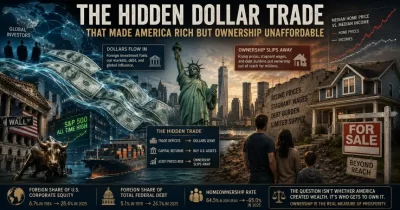
Most Americans look at these problems through a domestic lens. They assume they are participating in an economy built primarily around the needs of Americans. In reality, they are living at the center of a global dollar system. That distinction may explain more about the affordability crisis than most people realize.
The Dollar Is Not Just America’s Currency
Everybody talks about physical immigration, but almost nobody talks about monetary immigration. Billions of people around the world want access to U.S. dollars. That demand does not stop at our borders, and neither do its effects.
Most Americans think of the dollar as the money they earn, save, and spend. Globally, the dollar serves a much larger purpose. Governments hold it in reserve, international businesses use it to price goods, countries borrow in it, investors buy assets denominated in it, and families living under weak currencies often try to save in it whenever they can.
For someone living in a country with persistent inflation, political instability, capital controls, or an unreliable banking system, the U.S. dollar may represent protection. Their local currency may be losing value, their government may be restricting withdrawals, or their banks may not be trusted. In that environment, choosing dollars is rational.
The important question is not why the rest of the world wants dollars. The important question is what happens when billions of people seek safety, savings, and liquidity inside the same monetary system Americans already depend on.
Stablecoins Could Expand Global Dollar Demand
Historically, access to U.S. dollars outside the United States often required physical cash, foreign bank accounts, or participation in informal currency markets. Technology is changing that through stablecoins, which allow people to hold and transfer digital assets designed to track the value of the U.S. dollar.
In practical terms, stablecoins can give someone with a smartphone access to dollar-denominated value without requiring physical cash or a traditional American bank account. That is a major development because governments in struggling countries have often tried to limit access to foreign currencies by restricting dollar purchases, blocking transfers, or limiting withdrawals. Those policies may slow demand, but they rarely eliminate the reason people want dollars in the first place.
It is much harder to prevent people from using smartphones, internet connections, and digital wallets across an entire country. For someone concerned about theft, banking instability, or currency devaluation, holding dollar-based funds digitally may also feel safer than hiding physical cash.
This means access to the dollar system may become easier, faster, and more global than it has ever been. If the older petroleum-based dollar system becomes less important, widespread stablecoin adoption may become one of the most realistic ways for the United States to preserve and expand global dollar demand.
Why the United States Benefits From Global Dollar Demand
The United States has benefited for decades from the dollar’s central role in global trade and finance. That role helps create demand for U.S. government debt, strengthens American banks and financial institutions, and gives the United States substantial influence over payment systems, international trade, and capital flows.
These advantages are significant. Global demand for dollars and dollar-denominated assets can support Treasury markets, strengthen financial liquidity, and make it easier for the United States to finance itself compared with countries that issue weaker currencies.
However, the benefits of this system are not distributed equally among Americans. The same forces that strengthen financial markets and support asset values can also increase the cost of entering those markets.
This is where the affordability crisis becomes more complicated.
Why a Strong Financial System Can Still Feel Unaffordable
The American financial system does not only serve American workers, families, and businesses. It also serves global demand for dollars, Treasury securities, stocks, bonds, real estate, bank deposits, and other dollar-based financial products.
When capital flows into American assets, the people who already own those assets may become wealthier. Homeowners benefit when property values rise. Investors benefit when stocks and bonds appreciate. Business owners benefit from ownership, pricing power, and access to capital.
People who do not already own those assets experience the same system differently. Renters watch down payments move further out of reach. Younger workers watch home prices rise faster than their savings. Families without investments see asset values increase while their wages struggle to keep pace with the cost of housing, insurance, healthcare, food, and childcare.
The result is an economy that can look strong from the perspective of markets while feeling weak from the perspective of households.
This does not require a conspiracy. It only requires a financial system in which asset ownership compounds faster than wages.
Ownership Is Becoming More Important Than Income
We have all heard the phrase, “The rich get richer and the poor get poorer.” The more important issue is that ownership compounds.
A person with a moderate income who inherited a home may be in a stronger financial position than someone earning more but paying market rent. A family with investments may benefit from rising asset prices while another family is still trying to save enough money to participate. Two people with similar incomes can live in completely different economic realities depending on what they already own.
That changes the meaning of the middle class. Historically, a middle-class income could often support homeownership, savings, retirement, and family formation. Today, income alone may not be enough if the cost of acquiring assets continues to rise faster than wages.
The middle class may continue to exist in theory while becoming much harder to enter in practice. People can still work hard, earn more, save, and improve their position, but the distance between earning income and acquiring meaningful assets keeps growing.
This is where the concern about a practical caste system begins. Not a formal caste system written into law, but a financial one in which a person’s starting position determines more of their future. People who inherit homes, investments, businesses, and financial knowledge may live in a different economy from those who do not.
Why Young Americans Feel Something Is Breaking
Talk to almost any young adult and you will hear some version of the same frustration. Many do not believe they will have the same opportunities their parents had. They do not expect homeownership to be easy, they do not trust that retirement will be secure, and many are delaying marriage and children because they are not convinced they can afford the life they were told to build.
Talk to people who strongly identify with either the political right or the political left and you often get the same feeling. They disagree on the cause, they disagree on who should be blamed, and they disagree on what should replace the current system, but many agree that the current direction is not sustainable.
As financial pressure increases, politics stops being entertainment and becomes personal. People become more politically active when government policy affects whether they can afford housing, healthcare, food, education, retirement, or a family. They are increasingly pushed to pick a side.
What this eventually looks like, I have no idea. What seems clear is that financial pressure does not remain financial forever. It becomes political, cultural, and institutional.
Why Policymakers May Accept the Tradeoff
It is easy to assume policymakers simply do not understand what is happening. That may be true in some cases, but it is also possible that people with actual power understand the tradeoffs and believe the alternatives are worse.
The United States is competing inside a global financial system. China wants influence, Europe wants influence, emerging economies want alternatives, and trade, energy, and payment systems are all shifting. If global demand for the dollar weakens, the United States could face higher borrowing costs, reduced demand for government debt, less influence over international finance, and a weaker position in global trade.
From the perspective of national power, preserving global dollar demand may not feel optional. Stablecoins may provide a way to expand global dollar use even as older financial arrangements become less reliable.
If that is true, policymakers may view the current path as the least bad option. The alternative could be worse.
That does not mean the domestic consequences should be ignored. It means the country may be accepting rising inequality and declining affordability as part of a much larger financial tradeoff.
Whether that tradeoff is intentional, unavoidable, or simply allowed to continue is the question worth asking.
The Political Risk of Permanent Unaffordability
People will tolerate a great deal when they believe life is improving. They tolerate much less when they believe the system is permanently closing around them.
If housing, healthcare, education, insurance, and family formation continue becoming less affordable, more Americans will conclude that the existing system does not work for them. Some will demand larger government programs, while others will demand deeper cuts. Some will blame corporations, immigrants, the wealthy, the Federal Reserve, Wall Street, or foreign governments.
The specific political response is difficult to predict, but the direction is easier to see. A population under constant financial pressure becomes less trusting, more polarized, and more willing to support dramatic political change.
The eventual risk is not merely that life becomes more expensive. It is that people stop believing the system deserves to continue.
The Affordability Crisis Is Bigger Than Inflation
When Americans ask why everything feels so unaffordable, they are usually given a narrow answer such as inflation, interest rates, government spending, corporate greed, supply chains, immigration, or housing shortages. Each of those may explain part of the problem, but none of them fully explains the structure around it.
The U.S. dollar is global. American assets are global. American debt is global. American monetary policy is global. Stablecoins may make the dollar even more global than it already is.
Americans are not living inside a closed financial system designed only around their own needs. They are living at the center of a global monetary network that creates enormous power for the United States, but distributes its benefits unevenly.
For asset owners, financial institutions, and those already positioned inside the system, global dollar demand can produce wealth and opportunity. For everyone else, the same system may increasingly feel like higher prices, delayed ownership, and a middle-class life moving further out of reach.
Financial Pressure Is Also Changing Taxpayer Behavior
One consequence of the affordability crisis that receives almost no attention is how it changes taxpayer behavior.
As a CPA, I have seen that when households can no longer cover housing, food, insurance, healthcare, childcare, and other necessities, some begin treating unpaid taxes as a source of short-term cash flow.
The IRS Becomes an Unwilling Lender
In effect, they are making the IRS an unwilling lender.
The logic is understandable. A taxpayer may decide that paying rent, buying groceries, or keeping the lights on is more important than paying the IRS. Low audit rates and limited enforcement visibility can also create the impression that the government will not collect anytime soon.
The filing data deserves some caution. As of May 8, 2026, the IRS had received slightly fewer returns than it had at the comparable point in the prior filing season. That does not prove taxpayers are intentionally delaying filing because they cannot pay, nor does it prove financial hardship is the reason. Electronic filing actually increased. However, delayed filing is something worth watching during a period when so many households are under visible financial pressure.
Failing to File Is Usually the More Expensive Choice
What taxpayers need to understand is that the IRS is one of the most expensive lenders they can choose.
Many people assume they should avoid filing because they cannot afford to pay. In almost every case we represent, the opposite is true.
If you cannot pay your tax balance, file the return anyway.
The failure-to-file penalty is generally 5 percent of the unpaid tax for each month the return is late, subject to a maximum. When both the failure-to-file and failure-to-pay penalties apply, the combined penalty is generally limited during the overlapping period, but the cost still becomes substantial very quickly. Interest also begins accruing from the original due date.
In practical terms, failing to file often adds thousands of dollars to a tax debt without providing the taxpayer any additional benefit.
That is why filing the return and working through payment alternatives is usually far less expensive than refusing to file altogether.
Tax Relief Is Not the Same as Escaping the Debt
There are legitimate collection alternatives for taxpayers who genuinely cannot pay in full, including installment agreements, temporary hardship status, and Offers in Compromise. Unfortunately, television commercials promising to settle tax debt for “pennies on the dollar” leave out the most important part.
The IRS evaluates a taxpayer’s income, allowable living expenses, equity in assets, and future ability to pay. If someone has the ability to pay over time or through available assets, they generally will not qualify for a dramatically reduced settlement.
Using unpaid taxes to survive may solve today’s cash flow problem.
It also creates tomorrow’s collection problem.
Business Owners Face an Even Greater Risk
The same financial pressure affecting households is also affecting businesses. The difference is that business owners have access to another source of short-term cash flow that carries much greater consequences.
When cash flow becomes tight, some owners begin delaying payroll tax deposits to cover payroll, rent, inventory, vendors, or other operating expenses.
This is fundamentally different from delaying payment of a personal income tax balance.
Payroll Taxes Are Not Business Working Capital
When a business withholds federal income tax, Social Security tax, and Medicare tax from an employee’s paycheck, that money no longer belongs to the business. The business is holding those funds in trust until they are remitted to the United States Treasury.
Meanwhile, the employee’s paycheck and Form W-2 still show those taxes as having been withheld. The employee receives credit for those withholdings when filing a tax return, regardless of whether the employer actually sent the money to the government.
In other words, the government has already honored the employee’s tax payment on paper.
The employer has simply kept the money.
That is why the IRS treats unpaid payroll taxes much more seriously than most business owners realize.
The Trust Fund Recovery Penalty Can Create Personal Liability
If payroll taxes are not paid, the IRS may investigate who was responsible for collecting, accounting for, and paying those taxes. Owners, officers, managers, bookkeepers, or anyone with authority over the business’s finances can become personally liable through the Trust Fund Recovery Penalty.
Limited liability companies and corporations generally do not protect responsible individuals from this assessment.
Many owners assume they are borrowing from the government.
The government sees it differently.
From the Treasury’s perspective, those funds were never the business’s money to borrow. They were withheld from employees, reported as paid on payroll records and Forms W-2, and were supposed to be delivered to the government.
Willful Nonpayment Can Become a Criminal Matter
Most payroll tax cases remain civil matters, and many businesses work with the IRS to resolve them. However, when someone willfully withholds payroll taxes, repeatedly chooses to pay other creditors instead of the Treasury, or conceals what they are doing, the consequences can become much more serious.
IRS Criminal Investigation regularly investigates employment tax schemes, and business owners have been prosecuted and sent to federal prison for intentionally failing to pay over trust fund taxes.
Financial pressure explains why someone may make that decision.
It does not protect them from the consequences.
Whether you are an individual taxpayer or a business owner, using the IRS as an unwilling lender may provide temporary relief, but it rarely solves the underlying financial problem. It simply converts today’s affordability crisis into tomorrow’s tax crisis.
My Final Thoughts
Millions of Americans are struggling with the cost of living. Many are working, earning what would once have been considered decent money, and still feel unable to get ahead. Some are now making increasingly dangerous financial decisions simply to keep their households or businesses operating.
They are relying on credit cards, draining retirement accounts, delaying tax payments, and in some cases using payroll tax funds that were never theirs to spend. These decisions may solve an immediate cash-flow problem, but they create a much larger financial problem later.
Most Americans were never taught that the U.S. dollar is not merely the currency they use at the grocery store. It is the foundation of a global financial system. Billions of people want access to it, countries depend on it, governments compete over it, and technology is making it easier to use everywhere.
That demand does not stop at our borders, and neither do its effects.
The question is not whether the United States benefits from the dollar’s global role. It clearly does. The question is who receives those benefits, who absorbs the costs, and how long Americans will tolerate an economy that appears strong while ordinary life becomes increasingly unaffordable.
We should also be asking what people will do when they can no longer make the numbers work.
When households begin using debt, retirement savings, and unpaid taxes to cover basic necessities, they are financing today’s survival with tomorrow’s income. When business owners begin using withheld payroll taxes to keep the doors open, they are doing the same thing with even greater legal and financial consequences.
At that point, the affordability crisis is no longer just about higher prices.
It is consuming the future financial stability of the people living through it.
Need Help Resolving an IRS or State Tax Problem?
If you have unfiled tax returns, unpaid tax balances, payroll tax debt, IRS notices, or other tax resolution concerns, delaying the issue can make the financial consequences worse.
Corridor Consulting- Certified Public Accountants helps individuals and business owners understand their options, become compliant, and develop a strategy for resolving federal and state tax problems.
Contact Corridor Consulting to discuss your tax resolution situation and determine the appropriate next step.